What Jeff Cooper Taught Us About the Armed Citizen
A reflection from the classroom. Before every class begins, there is a moment when the room grows quiet. Students settle into their chairs. Some are a little nervous. Others are curious. A few still look unsure about what they have signed up for. Most of them have never taken a firearms class before. What they share, however, is the quiet realization that something in the world has changed for them. At some point, each of them decided they no longer wanted to be passive observers of their own safety. Every concealed carry class begins the same way. Before we talk about holsters, shooting fundamentals, or the law, I ask each student to introduce themselves and answer one simple question: “Why are you here?” The answers are rarely dramatic. Most people simply say they want to protect themselves or their families. Some talk about the uncertainty of the world today. Others explain that they believe responsible adults should not be helpless if violence ever finds them. Over time, I’ve learned that this question reveals something important. Every person who walks into a concealed carry class has made a decision. They have chosen responsibility over complacency. They have decided that if the worst day of their life ever arrives, they want to be better prepared for it. Occasionally, a student says something that reminds everyone in the room exactly why the training matters. In a class I taught this past December, one of my students stood up and introduced himself. He explained that he was Jewish and that for most of his life he had never felt the need to carry a firearm. But recently, he said something had changed. For the first time in his life, he had begun experiencing open antisemitism. Not something he had read about in history books. Something personal. He told the class that he simply wanted the ability to protect himself if he ever needed to. That evening, after the first day of class ended, reports began emerging from Australia. News outlets were reporting a deadly attack in Sydney, which would soon become known as the 2025 Bondi Beach shooting. Suddenly, the discussion we had just finished in the classroom was no longer theoretical. It was unfolding in real time. The attack occurred during a large Hanukkah celebration near Bondi Beach, where members of the Jewish community had gathered for an outdoor event known as “Chanukah by the Sea.” Families, children, and elderly members of the community were present. It was meant to be a peaceful holiday celebration. According to reports, two gunmen positioned themselves on a nearby footbridge overlooking the park area and opened fire into the crowd below. The attackers had also brought improvised explosive devices, which fortunately failed to detonate. The attack unfolded rapidly. In a matter of minutes, the celebration turned into chaos as people ran for safety and others tried desperately to help the wounded. Law enforcement officers moved quickly toward the gunfire and engaged the attackers, stopping the attack within minutes. But by then, innocent lives had been lost, and many others had been injured. Like many violent incidents around the world, it was sudden, unpredictable, and over in a very short period of time. By the time our class reconvened the next morning, more details had begun to emerge. Instead of ignoring it, we talked about it. For nearly two hours the class discussed the attack. We analyzed how quickly violence can unfold in crowded public places. We talked about situational awareness, movement, and how ordinary people respond under stress. We discussed the difficult realities of making decisions when seconds matter and information is incomplete. Those conversations are never about fear or sensationalism. They are about responsibility. Because concealed carry is not about bravado. It is not about fantasy. It is about understanding that violence exists in the world and preparing oneself mentally and morally for the possibility of confronting it. For me, that understanding became deeply personal years ago during the 2017 Las Vegas shooting. Like many people who were there that night, I experienced firsthand how quickly normal life can turn into chaos. One moment people were enjoying a concert. The next, thousands were running for their lives. Moments like that have a way of changing how a person sees the world.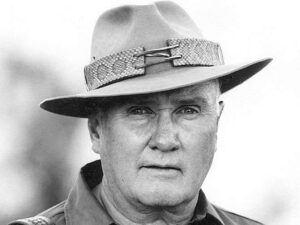
"Owning a handgun doesn't make you armed any more than owning a guitar makes you a musician." ~ Jeff Cooper
The Mind Matters More Than the Gun
In the decades after World War II, most handgun training in America focused on slow, one-handed target shooting. Pistols were largely treated as sporting tools rather than defensive weapons. Jeff Cooper believed that approach ignored reality. Drawing on his experience as a Marine officer and a lifelong student of firearms, Cooper began developing what he called the Modern Technique of the Pistol, a practical system for fighting with a handgun that emphasized efficiency, control, and decisiveness. Many of Cooper’s ideas were influenced by a Los Angeles County deputy sheriff named Jack Weaver, whose innovative two-handed shooting stance proved dramatically more effective during early combat pistol competitions. The first time I ever heard about those early experiments in practical pistol shooting was not from a book. I was sitting in a classroom. I was taking an instructor course from my local NRA Counselor, TJ Johnson, owner of All Safe Defense. TJ became an important mentor to me. Like many good instructors, he spent just as much time talking about where our training traditions came from as he did teaching the mechanics of shooting. It was in that classroom that I first heard about the early combat pistol competitions held in Big Bear, California. Those competitions became known as the Leatherslap matches, held during the late 1950s and early 1960s. Shooters gathered to test practical handgun skills, drawing quickly, engaging targets under time pressure, and solving shooting problems that resembled real defensive situations. The matches became laboratories for modern pistolcraft. Techniques were tested. Refined. Sometimes discarded. What survived was what worked. In many ways, that moment in TJ’s classroom illustrated an important aspect of the firearms community. Knowledge is not just written in books. It is passed from instructor to student. From one generation to the next. And every responsible instructor carries a piece of that history forward. Cooper eventually formalized these ideas at Gunsite Academy in Paulden, Arizona. Gunsite became the first institution dedicated entirely to defensive firearms training and helped spread these principles throughout the firearms community. Today, nearly every reputable defensive pistol course, whether taught to civilians, law enforcement officers, or military personnel, can trace its roots back to Cooper’s work.
The Elements of Pistolcraft
As civilian firearms training evolved in the United States, one name appears again and again: Jeff Cooper. Through his work at Gunsite and his writings in books like To Ride, Shoot Straight, and Speak the Truth, Cooper helped define what we now call modern pistolcraft. He often reduced the problem of gunfighting to three simple elements: Accuracy. Power. Speed. In the classroom, I often remind students that the order matters. First, you must hit. Then the hit must matter. Only then does speed enter the equation. This idea later became formalized in the Latin motto DVC: Diligentia, Vis, Celeritas, which translates to accuracy, power, and speed, and remains the motto of the International Practical Shooting Confederation. The lesson is straightforward but important. Many new shooters focus on speed first. They want to draw, shoot, and move quickly. But speed without accuracy accomplishes nothing. And accuracy without sufficient power may not stop a violent threat. The responsible armed citizen understands that effectiveness is the balance of all three. You must place your shot where it needs to go, deliver it with enough force to matter, and do so quickly enough to prevail in the moment that matters most.But Cooper believed the most important weapon was not the handgun. It was the mind. He famously described situational awareness through his color code system: white, yellow, orange, and red. The idea was simple. Surviving violence begins long before a firearm is ever drawn. Awareness, judgment, and mental preparation matter more than speed or marksmanship alone. Those principles remain central to responsible firearms training today. In every class I teach, we spend as much time discussing judgment as we do mechanics. Students learn not only how to draw a firearm and fire accurately, but also when not to.
- Avoidance.
- De-escalation.
- Understanding the legal and moral responsibilities that come with carrying a firearm.
- Engineers.
- Business owners.
- Nurses.
- Parents.
- Retirees.
A Creed for the Responsible Citizen
- Train with discipline.
- Carry with responsibility.
- Refuse to be helpless.