What Did You Know at the Time?
Why Documenting Your Training Could Matter More Than You Think
By Tom Durell, Not Today Self-Defense & Firearms Training
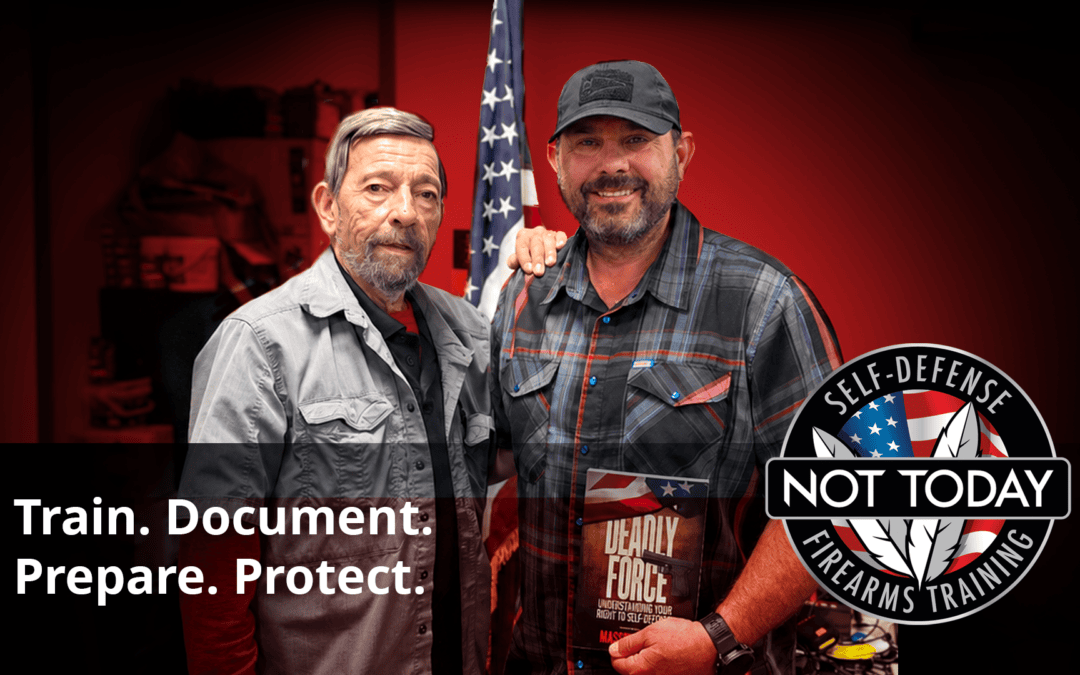
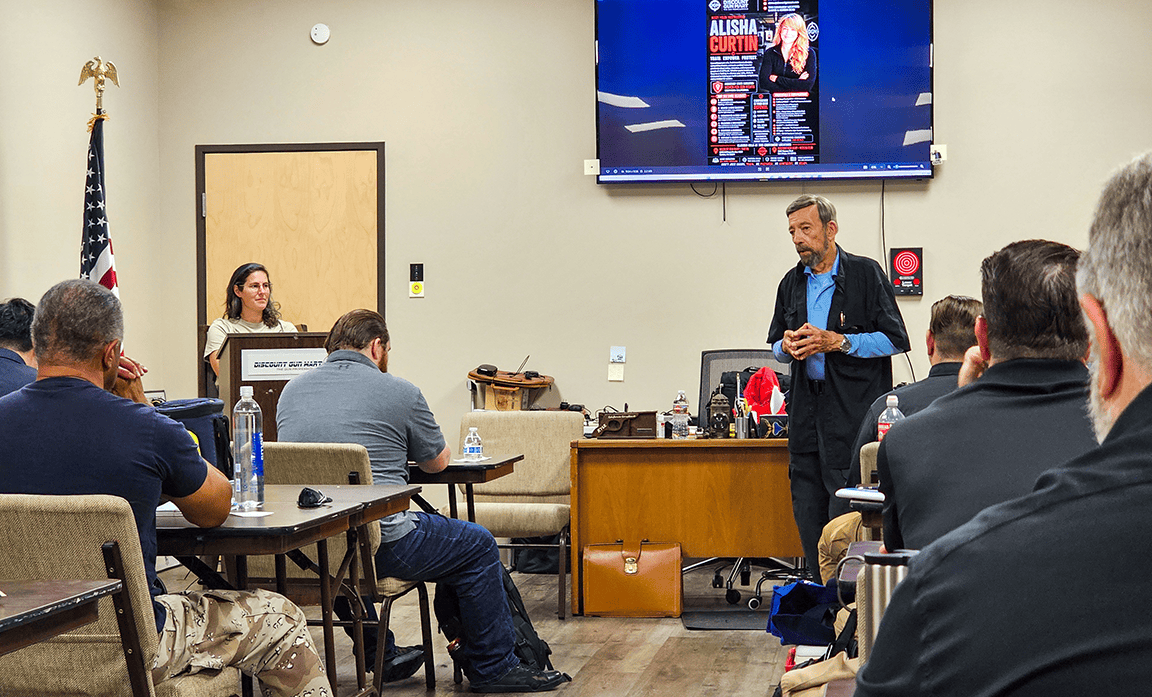
In July, I spent 40 hours in a classroom with Massad Ayoob, and if you’ve never sat through one of his courses, understand this: the man is a walking library. Forensic evidence, courtroom advocacy, the history of major use-of-force cases, the psychology of fear, expert witness testimony. I could write a dozen articles and still not cover everything he packed into that week.
For those unfamiliar with him, Massad Ayoob has been teaching police techniques and civilian self-defense since 1974. He founded the Lethal Force Institute in 1981 and directed it until 2009, when he launched the Massad Ayoob Group, the banner he now teaches under. He served as a part-time police officer for over four decades, retiring in 2017 as a captain, and has worked as a courtroom expert witness in weapons and shooting cases since 1979. He’s authored more than a dozen books, including In the Gravest Extreme and Deadly Force, both considered foundational texts on the legal use of lethal force, along with over a thousand articles on firearms, combat, and self-defense law. In 2020, he was named president of the Second Amendment Foundation. Suffice it to say, when Ayoob talks about what juries expect and how courts evaluate self-defense claims, it’s coming from someone who has sat in that courtroom seat more times than almost anyone else teaching today.
As an instructor, I try to keep looking for that next piece, something that might help my students, something that might sharpen the class a little more. When I find it, I put in the time to learn it properly. I’m far from the only one doing this. The longer you’re in this world, the more you start recognizing other instructors who take it just as seriously. You see the same faces show up at conferences, classes and training nobody made them attend. Over time, you get a feel for who’s genuinely doing the work. My own training schedule reflects that; I already have more classes lined up for later this year. It’s something I’ve cared about since I started this company: keeping learning and bringing my students training that’s current and worth their time.
But here’s the problem that comes with it. Imagine sitting through a 40-hour Deadly Force Instructor course. 40 hours of information. 40 hours of analysis. 40 hours of education. Then try to figure out how to pass that on to your CCW students in an 8-hour renewal, or a 16-hour initial class. You can’t. Not all of it. You must pick your battles, find the point that adds the most value to the people sitting in front of you, and then get back to the county and state required curriculum.
So instead of trying to summarize 40 hours in a single newsletter, I picked the one lesson I think matters most for my students right now, the one most likely to change something you do this month, not just something interesting to know.
There were many different subjects I could have chosen to write about for this article: furtive movement, disparity of force, bare fear vs. reasonable fear, the list goes on. But I chose this one, and it’s the lesson I carried into my classroom the very next class I had.
Most people think about firearms training in terms of what it allows them to do.
Can I draw efficiently? Can I hit the target? Can I clear a malfunction? Can I recognize when deadly force is legally justified?
After spending a week studying under Massad Ayoob in his Deadly Force Instructor course, I came home thinking about a different question, one that could become extraordinarily important if a person ever has to defend their actions in court:
Can you prove what you knew before the incident happened?
That distinction matters more than most people realize.
What Did You Know When You Made the Decision?
A defensive encounter may unfold in seconds. A criminal investigation and court case can examine those seconds for months or even years.
By the time it reaches the courtroom, everyone knows how the incident ended. Investigators have photographs. Attorneys have reports. Experts have analyzed the evidence. Witnesses have been interviewed. Video may have been reviewed frame by frame.
The person who actually experienced the event had none of that information. They had only what they knew, saw, heard, perceived, and reasonably believed in that moment.
That’s an important distinction in self-defense law.
California’s self-defense jury instructions, CALCRIM 505 and CALCRIM 3470, among others, direct jurors evaluating the reasonableness of a defendant’s beliefs to consider the circumstances as they appeared to the defendant, and what a reasonable person with similar knowledge in a similar situation would have believed.
In other words, hindsight isn’t supposed to be the standard. The legal question isn’t “what would you have done?” It’s closer to: what would a reasonable, prudent person have done, knowing what the defendant knew at the time? That comes down to three things: a reasonable person, facing the same circumstances, with the same knowledge available to the defendant.
That’s where training comes in.
Training Changes What You Know
Consider a CCW student who’s received solid instruction on reaction time, distance, disparity of force, pre-assault indicators, weapon access, physiological responses to extreme stress, or how quickly an attacker can close distance.
Those aren’t just interesting facts picked up in a classroom. They become part of that student’s knowledge base.
Years later, if that student is confronted by someone with a contact weapon, they may recognize the danger differently than someone who’s never studied the subject, because they knew something before the encounter happened.
To be clear: training doesn’t automatically make the use of force reasonable or lawful. It’s not a license to act. Every incident is evaluated on its own facts.
But training can help explain why a defender perceived a situation as dangerous, and why they made the decisions they made.
Which raises the next question: how do you establish that you actually possessed that knowledge before the incident?
Here’s a concrete example of the kind of knowledge we’re talking about. Ayoob teaches a three-part framework for evaluating whether deadly force is justified: Ability, Opportunity, and Jeopardy (AOJ). Does the attacker have the ability to cause death or serious injury? Do they have the opportunity to use it immediately? And do their actions show jeopardy, a clear intent to do so? Take away any one of those three, and justification becomes difficult to establish.
The Tueller Drill, first run at Gunsite in 1983, is often cited to illustrate the “opportunity” leg: a motivated attacker with a contact weapon at roughly 21 feet can close that distance in about a second and a half to under two seconds, often faster than a defender can recognize the threat, decide to act, and respond. A trained student knows that. An untrained person may not. That single piece of knowledge can be the difference between recognizing danger in time and not recognizing it at all, and it’s exactly the kind of thing a documented training record can help demonstrate you knew before you ever needed it.
Massad Ayoob’s Surprisingly Simple Answer
 During the Deadly Force Instructor course, Massad Ayoob spent considerable time on this exact problem: documentation.
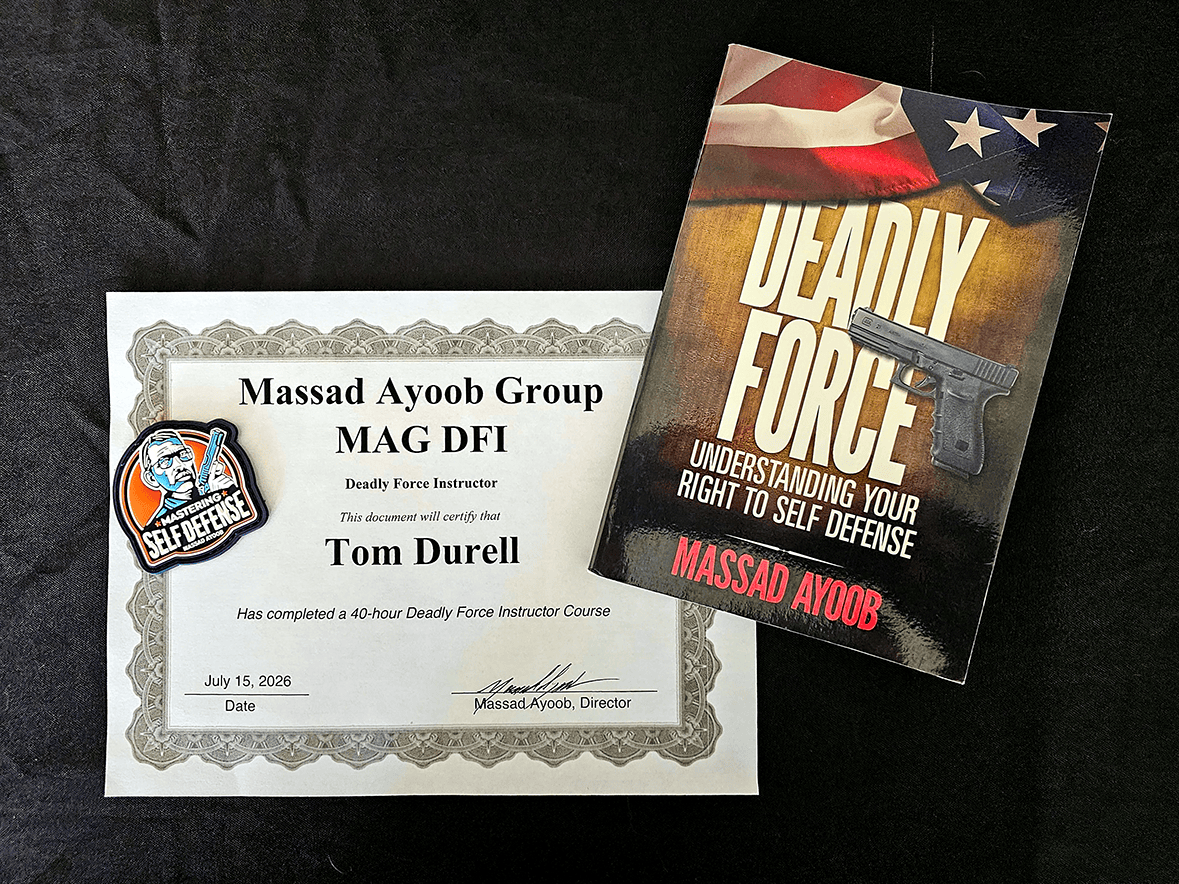
Keep your certificates. Keep your course materials. Keep your notes. Keep records of your training.
Then he offered something refreshingly old-school: put copies of your important training records into an envelope, mail them to yourself, and leave the envelope sealed.
In an age of cloud storage, that can sound almost quaint. But there’s a real purpose behind it. A postmarked, sealed package can serve as contemporaneous evidence that those materials existed before a later incident.
Imagine an attorney asking:
“Isn’t it true you learned all of this after the shooting, while preparing your defense?”
A documented training history helps answer that question honestly and convincingly, because the goal isn’t to manufacture evidence after the fact. It’s the opposite: document your education before you ever need it.
Your Training Record Tells a Story
This reframed how I look at the stack of certificates most serious students eventually accumulate. They aren’t souvenirs. Together, they document real development over time.
A well-kept training file might eventually include:
- CCW training and renewals
- Defensive-firearms courses
- Medical and trauma training
- Force-on-force or scenario training
- Books and educational materials studied
- Certificates from recognized training organizations
- Notes from courses
- Qualification records
- Continuing education
Taken together, that collection creates a timeline, one that can show a student was studying avoidance, de-escalation, judgment, self-defense law, threat recognition, medical response, and responsible use of force long before any incident occurred.
There’s another benefit that may matter just as much: keeping records encourages continued learning. A CCW permit should never represent the end of someone’s education. It should represent the beginning.
What This Looks Like in Practice
A training log doesn’t need to start as a legal safeguard; mine didn’t. For years it was simply a way to track expenses and tally hours, dates, and locations. After completing Massad’s course, though, it became clear those old records had a second purpose. I compiled them, printed them, and mailed the packet to myself, sealed, as a dated record.
The format is straightforward: organization, course name, date, and hours. Attach your notes from each class or seminar as you go. Below is a sample from my own training for just this year, 2026, the full record goes back years, with every course, organization, date, and hour logged.
| Organization | Course | Date | Hrs |
| USCCA | Defensive Pistol, AZ | 04-11-26 | 16 |
| Lt. Col. Dave Grossman & Susan Lewis Simons | Under the Shield Seminar, Phoenix, AZ | 05-05-26 | 16 |
| Krav Maga Israel | Integrated Home Defense, Houston, TX | 06-11-26 | 40 |
| Massad Ayoob Group | Deadly Force Instructor, San Diego, CA | 07-11-26 | 40 |
| USCCA | Control the Bleed Seminar Guest Speaker – Fullerton, CA 5.11 Store |
08-17-26 | 1 |
| NRA | Counselor Development Workshop, Arnold, MO | 09-21-26 | 40 |
| USCCA | Control the Bleed Seminar Guest Speaker – Costa Mesa, CA 5.11 Store |
10-20-26 | 1 |
| Shivworks | ECQC Training | 11-20-26 | 24 |
| USCCA | FIDC | 12-07-26 | 40 |
That’s a single year, nearly 180 hours of training, across firearms, medical response, and legal training. No one entry carries much weight by itself. Taken as a whole, though, the log builds a timeline of what a person knew, and when they knew it.
A complete record should also include a running list of standing certifications and approvals. Here’s an example of how that section might look:
- California DOJ / P.O.S.T. Certified Firearms Instructor
- Approved CCW training provider with the Orange County and Riverside County Sheriff’s Departments
- NRA Certified Counselor: CCW, pistol, rifle, shotgun, Refuse To Be A Victim, Range Safety Officer, Home Firearm Safety, Personal Protection In/Outside the Home, and Metallic Cartridge Reloading
- NRA Certified Instructor: CCW, pistol, rifle, shotgun, Refuse To Be A Victim, Range Safety Officer, Home Firearm Safety, Personal Protection In/Outside the Home, and Metallic Cartridge Reloading
- USCCA Certified Instructor: CCW, Basic Pistol, Home Defense Fundamentals, Countering the Mass Shooter Threat, Emergency First Aid Fundamentals, and Church Safety
- FEMA “Active Shooter: What You Can Do”
- American Red Cross First Aid/CPR/AED Instructor certification
- Professional armorer certifications: Remington 870, M4/M16/AR-15, Glock 17/19/43X
Every serious instructor and student should build a record like this, not to impress anyone, but to be able to answer the one question that matters afterward: what did you know at the time?
Why Eight or Sixteen Hours Isn’t Enough
This is the same problem I described at the start. I sat in 40 hours with Ayoob and had to boil it down to one lesson worth your time. Every instructor worth their certification is doing that same filtering, every time they teach. The 8 or 16 hours you get isn’t the ceiling of what matters. It’s what fit.
California sets minimum, and I stress the word “minimum”, training requirements for concealed carry applicants and renewals, and those hours matter. But no responsible instructor should pretend a state mandated course turns anyone into an expert on every aspect of armed self-defense.
There’s simply too much to learn: law, judgment, conflict avoidance, human performance under stress, decision-making, firearms skills, medical response, and perhaps most importantly, understanding when not to use the firearm.
A responsible armed citizen keeps learning long after the permit is issued.
And now, add one more habit to that list: document the education.
Keep the certificate. Keep the course description. Keep your notes. Keep the book list. Keep qualification records. Keep a training journal. Store copies somewhere secure.
If you follow Ayoob’s method, periodically place copies of your significant records in a package, mail it to yourself, and keep it unopened.
A postmark isn’t magic. A self-mailed package doesn’t automatically make everything inside admissible in court; evidence still must satisfy the applicable rules. Think of it instead as one more piece of contemporaneous documentation supporting your training history.
The Question I Want My Students to Remember
Hopefully none of my students will ever have to explain a defensive encounter to investigators, attorneys, or twelve jurors. But preparedness means thinking through difficult possibilities before they happen.
If that day ever comes, the question won’t simply be “What did you do?”
The deeper questions will be: What did you perceive? What did you reasonably believe? Why did you believe it? What did you know at the time?
Your training may help provide those answers. Your training records may help establish that you possessed that knowledge long before you ever needed it.
That’s one more reason firearms training should never be viewed as just learning how to shoot. We’re learning how to recognize danger, make responsible decisions, protect innocent life, and, if the worst day ever comes, explain why we did what we did.
Train. Document. Prepare. Protect.
This is just one lesson from 40 hours with Massad Ayoob. Plenty more is worth sharing: jury psychology, articulation, courtroom survival, and the forensic realities of a defensive shooting. We even ran a moot court exercise after watching 10 to Midnight, an old Charles Bronson movie from the early ’80s: we had enough people in the class to split into two full twelve-person jury pools in two separate rooms and deliberate an innocent or guilty verdict. To my surprise, a room of twelve firearms instructors couldn’t agree on whether the shooting at the end of the movie was justified or not. That’s another story for another day. Look for more from this course in future issues.
This article is for educational purposes and is not legal advice. The admissibility and significance of training records depend on the facts, jurisdiction, and applicable rules of evidence. Consult a qualified attorney regarding any particular legal matter.