
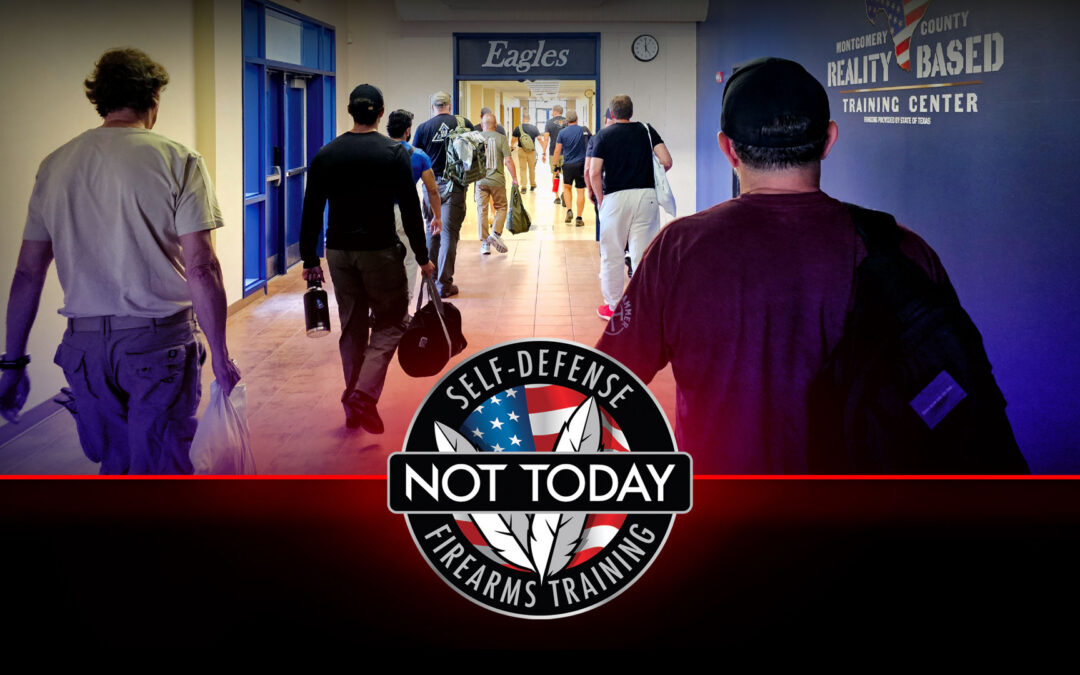
So That One May Walk in Peace
Lessons from Krav Maga Israel’s Integrated Home Defense Course
Course: Integrated Home Defense
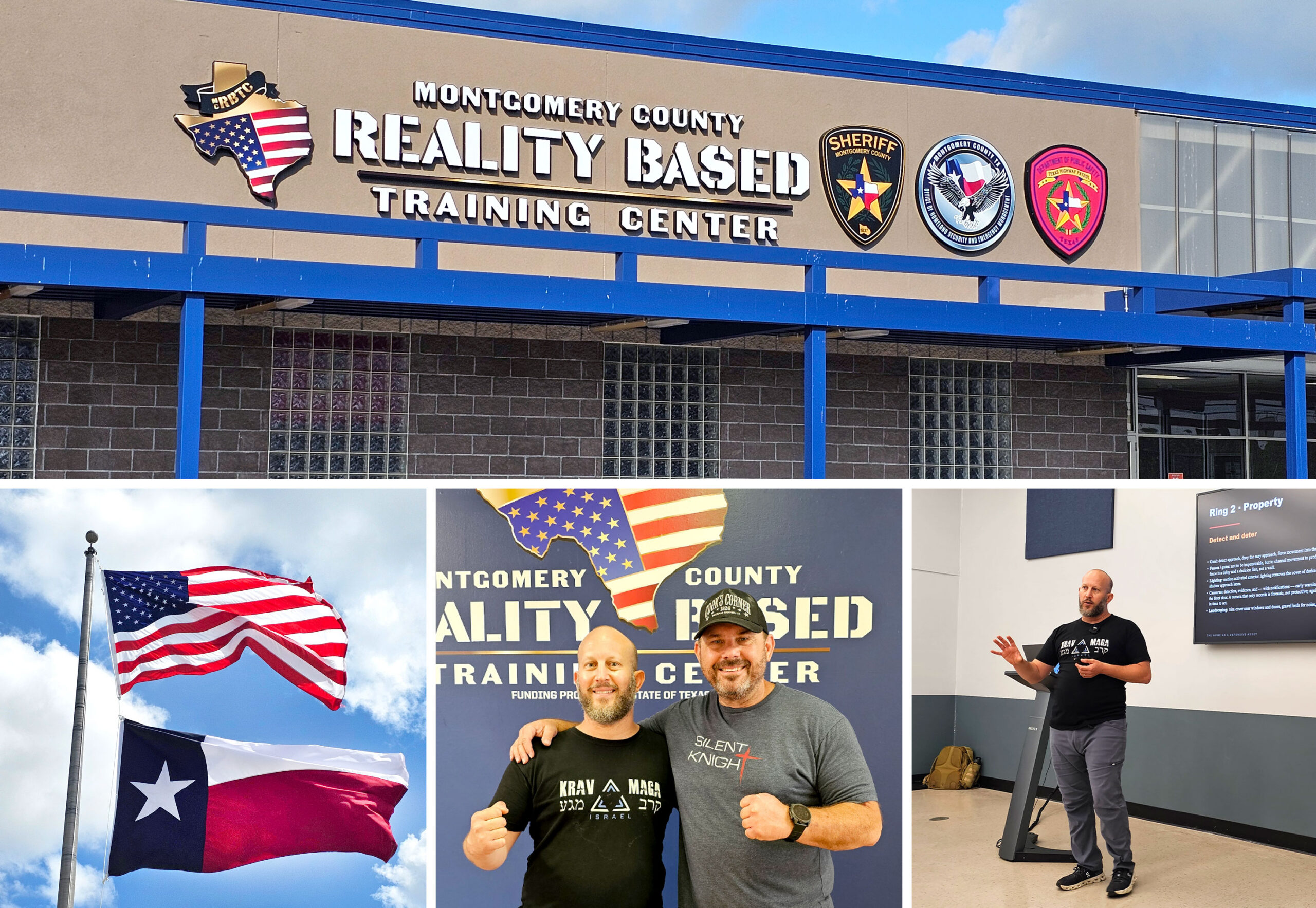
Host Site: Montgomery Co. Reality Based Training Center
Location: New Caney, Texas — 2026
Instructors: Ron Engelman, with Daniel Peña & Wesley Mack
Prepared by: Tom Durell | Not Today Defense
This is not an article about politics. It is an article about preparedness. October 7 serves as a case study, not because it happened in Israel, but because it reminds us that violence, confusion, and system failures can occur anywhere. The lessons that follow are about protecting families, creating time, making decisions under stress, and preparing before a crisis occurs.
Why I Went
I nearly didn’t attend this course. I had it booked, paid for, and on my calendar.
Like many working adults, I had plenty of reasons to stay home. Work obligations were piling up. I had responsibilities at home. As the class approached, I found myself questioning whether I should make the trip at all. A flight to Houston, hotel, food, rental car, and days off work, etc.
Then something happened.
A few weeks before the course, Ron Engelman, founder of Krav Maga Israel, sent all of the students a book recommendation over our WhatsApp group and encouraged us to read it before arriving: One Day in October – Forty Heroes, Forty Stories.
I downloaded the audiobook and began listening to it during my rucks around Lake Mission Viejo.
The stories immediately captured my attention. These weren’t stories about politicians, military leaders, or world events. They were stories about ordinary people: parents, husbands, wives, neighbors, and citizens who suddenly found themselves facing extraordinary circumstances on October 7th, 2023.
As I listened, something began to resonate with me. I realized the training Ron and his instructors were teaching wasn’t developed in a vacuum. Tragedy shaped it, and lessons were paid for at a tremendous human cost. And at that moment, I recognized something familiar: the same reason Ron teaches this material is the same reason I teach.
My own journey into firearms instruction, emergency preparedness, trauma medicine, and concealed carry training was shaped by another tragedy: Route 91.
On October 1, 2017, thousands of us arrived at a country music festival expecting nothing more than a weekend of music and memories. Within minutes, normal life disappeared. Confusion replaced certainty. Information was incomplete. People were injured. People were dying. Ordinary citizens were forced to make extraordinary decisions.
The details were different, but the lesson was the same: those who have witnessed tragedy often dedicate themselves to ensuring others are better prepared than they were.
That realization changed the way I viewed the course. I was no longer traveling to Montgomery County simply to learn new tactics or techniques. I was going to learn from people who had experienced the same calling that many of us in the preparedness community share: taking painful lessons and transforming them into knowledge that might help someone else survive.
It reminded me of something Lt. Col. Dave Grossman often says: “Love protects.”
That statement is easy to misunderstand. To some, preparedness seems driven by fear. To those who have lived through violence, the opposite is often true.
The father who installs better locks on his doors is not motivated by fear. He is motivated by love for his family.
The mother who learns trauma medicine is not motivated by fear. She is motivated by love for her children.
The citizen who attends training, develops emergency plans, and prepares for difficult situations is not preparing because he expects tragedy. He prepares because he hopes it never happens and wants the people he loves to come home safely if it does.
As the miles passed beneath my boots and the stories of October 7 played through my headphones, I realized that was the common thread connecting Route 91, Krav Maga Israel, and responsible preparedness. The training comes from love. Love protects.
What Is Krav Maga?
Before discussing the events of October 7, it helps to understand the training system that brought me to Texas in the first place.
Krav Maga, Hebrew for “contact combat,” is a practical self-defense system developed in Israel to prepare military personnel and civilians for the realities of violent encounters. Unlike many traditional martial arts that evolved over centuries as sports, cultural traditions, or competitive disciplines, Krav Maga was designed with a single purpose: to help ordinary people survive real-world attacks. Its founder distilled that purpose into a simple motto, one that gives this article its title: So that one may walk in peace.
The system traces its origins to Imi Lichtenfeld, a Hungarian-born boxer, wrestler, and martial artist who grew up in what is now Slovakia during Europe’s rise of fascism. In the 1930s, Lichtenfeld organized groups of Jewish volunteers to defend their neighborhoods from violent antisemitic attacks. Through those experiences, he learned that techniques which worked in a boxing ring often failed amid the unpredictability and chaos of actual violence. Survival required simple movements, aggressive counterattacks, quick decision-making, and the ability to adapt under extreme stress.
After immigrating to what would become the State of Israel, Lichtenfeld refined those concepts while training members of the Haganah, Israel’s pre-state defense organization, and later the newly formed Israel Defense Forces (IDF). The military needed a fighting system that could be taught to recruits from every background in a relatively short amount of time. Instead of requiring years of practice to master elaborate forms or highly technical movements, Krav Maga emphasized instinctive actions that could be learned quickly and performed under pressure.
Although often described as a martial art, Krav Maga is better understood as a self-defense system built around principles rather than hundreds of memorized techniques. Students learn to recognize danger early, move decisively, protect vulnerable areas of the body, counterattack when necessary, and escape as soon as it is safe to do so. The objective is not to defeat an opponent in a sporting contest; it is to survive a violent encounter and return home safely.
Modern Krav Maga has expanded far beyond military service. Today it is taught to law enforcement officers, security professionals, first responders, and civilians throughout the world. While individual organizations differ in curriculum, the core philosophy remains remarkably consistent: awareness comes before action, avoidance is preferable to confrontation, and violence should be used only when necessary to stop an immediate threat.
What impressed me most during the Integrated Home Defense course was that the instructors continually returned to these underlying principles. While we learned defenses against strikes, chokes, edged weapons, firearms, and other common assaults, the emphasis was never on collecting techniques. Instead, the focus was on situational awareness, decision-making under stress, protecting loved ones, and creating opportunities to escape danger whenever possible. The goal was never to win a fight; it was to get everyone home safely.
That philosophy closely mirrors the approach we teach at Not Today Self-Defense. Whether the subject is concealed carry, trauma medicine, emergency planning, or personal protection, our objective has never been to create people looking for conflict. It is to help responsible citizens recognize danger early, avoid violence whenever possible, and, if there is no other choice, respond lawfully and effectively to protect innocent life.
The Integrated Home Defense course expanded those same principles beyond individual self-defense. Rather than focusing solely on fighting skills, it examined how families prepare for violence before it occurs, through awareness, planning, communication, layered home security, and decisive action when every second matters. Many of those lessons were refined after the attacks of October 7, 2023, and they offer valuable insight for anyone interested in protecting the people they love.
Understanding Krav Maga matters because it explains the mindset behind everything that follows: preparation over panic, awareness over complacency, and an unwavering commitment to protect innocent life. With that foundation in place, it becomes easier to understand why October 7 fundamentally reshaped the way Israeli instructors think about personal and family security.
Who Is Ron Engelman?
It’s worth knowing something about the man who put this course together, because his story is, in many ways, the same story this whole article is trying to tell.
Ron Engelman was born in Israel to a family of Holocaust survivors. He has talked openly about what that inheritance taught him early: what it means to be powerless to defend yourself or protect the people you love, and the understanding that ultimately, we are the only ones responsible for our own safety. That early experience pushed him toward Krav Maga, and later toward the Israeli army, where he still serves today as a commander and senior Krav Maga instructor.
Ron is a Master Sergeant in the IDF with more than two decades of Krav Maga experience, and a combat veteran of the Second Lebanese War and numerous counter-terror operations in Gaza and the West Bank. After earning a spot in one of Israel’s decorated combat units, his commanders sent him to complete the military Krav Maga instructors course, and he went on to serve as his unit’s head Krav Maga instructor, training soldiers in close-quarters fighting alongside his combat role. He’s since built a reputation as a “trainer of trainers,” certifying instructors across Israel, the U.S., Europe, and Asia. He’s the founder and head instructor of Krav Maga Israel, the founder of the Krav Maga Defence Institute in Sydney, and the host of his own podcast, where he sits down with experts on violence, survival, and human performance under pressure. He co-taught this course alongside fellow instructor Daniel Peña.
None of that is background trivia. It’s why the Integrated Home Defense course exists at all, and why it doesn’t feel like it was written by a committee. Ron teaches lessons born of his family’s powerlessness, refined over twenty years of actual combat, and then refined again through the worst day in his country’s recent history. When he sent us that book recommendation over WhatsApp weeks before the course even started, it wasn’t a marketing touch. It was the same instinct running through everything else he does: take a painful lesson and hand it to someone else before they have to learn it the hard way.
The Home Team: Daniel Peña and Wesley Mack
Alongside Ron were Daniel Peña and Wesley Mack, two Montgomery County law enforcement veterans who know that building, that facility, and that kind of training inside and out.
Daniel Peña serves as Deputy Director of the Montgomery County Office of Homeland Security and Emergency Management, but his path there ran through more than two decades as a Texas Peace Officer with the Montgomery County Sheriff’s Office. He started as a Civilian Jailer and worked his way up through Jail Deputy and Patrol Deputy before landing on the SWAT team, where he eventually served as Team Leader and Dignitary Protection Team Lead, picking up specialties along the way as a Breacher, Grenadier, Tactical Medic, and Sniper. Before any of that, he was an Airborne Infantryman in the U.S. Army, and he later spent time in Iraq as a private security contractor for the State Department, providing high-threat protection and paramedic care. He holds a bachelor’s degree in Homeland Security and Emergency Management, a master’s degree in security management, and a paramedic license, on top of instructor certifications in Gracie Survival Tactics, Krav Maga law enforcement and military instruction, dignitary protection, and a long list of ALERRT and tactical medicine courses. These days he teaches dignitary protection courses internationally. Put simply, when he was standing next to Ron during the home defense lecture blocks, he wasn’t reciting material he’d only studied. He’d lived most of it.
Wesley Mack, the center’s Manager of Training Operations, brought a different kind of depth to the room. He retired as a Lieutenant after 26 years with the Montgomery County Constable’s Office, Precinct 1, and holds certifications in Basic and Advanced SWAT, firearms instruction, court security instruction, and several ALERRT disciplines. Between the two of them, Daniel and Wesley made sure the course wasn’t just Ron’s material dropped into an unfamiliar building. It was Ron’s material run by people who had spent their own careers preparing for exactly the kind of incidents this training exists to prevent.
Inside the Gym: What the Course Actually Looked Like
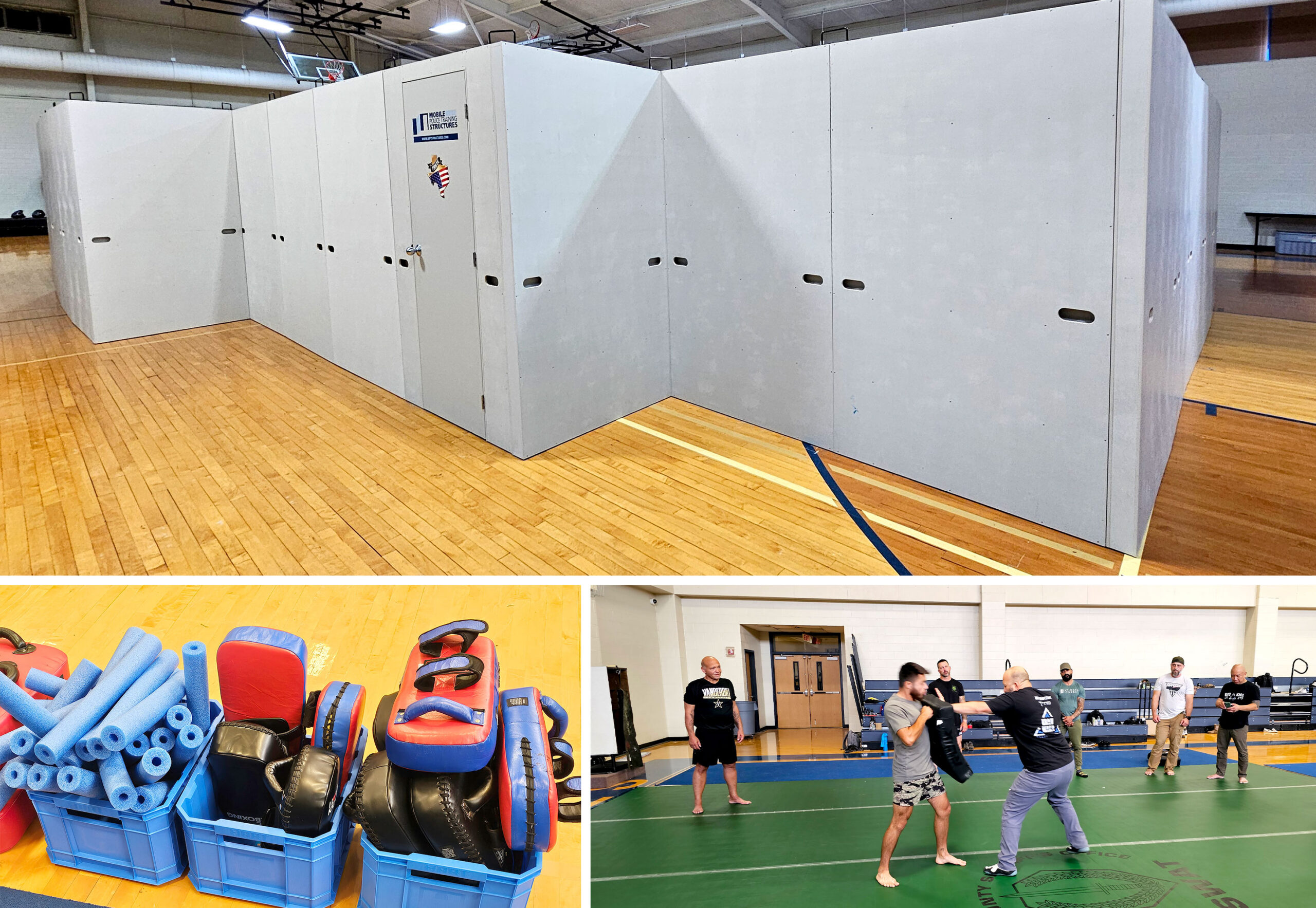
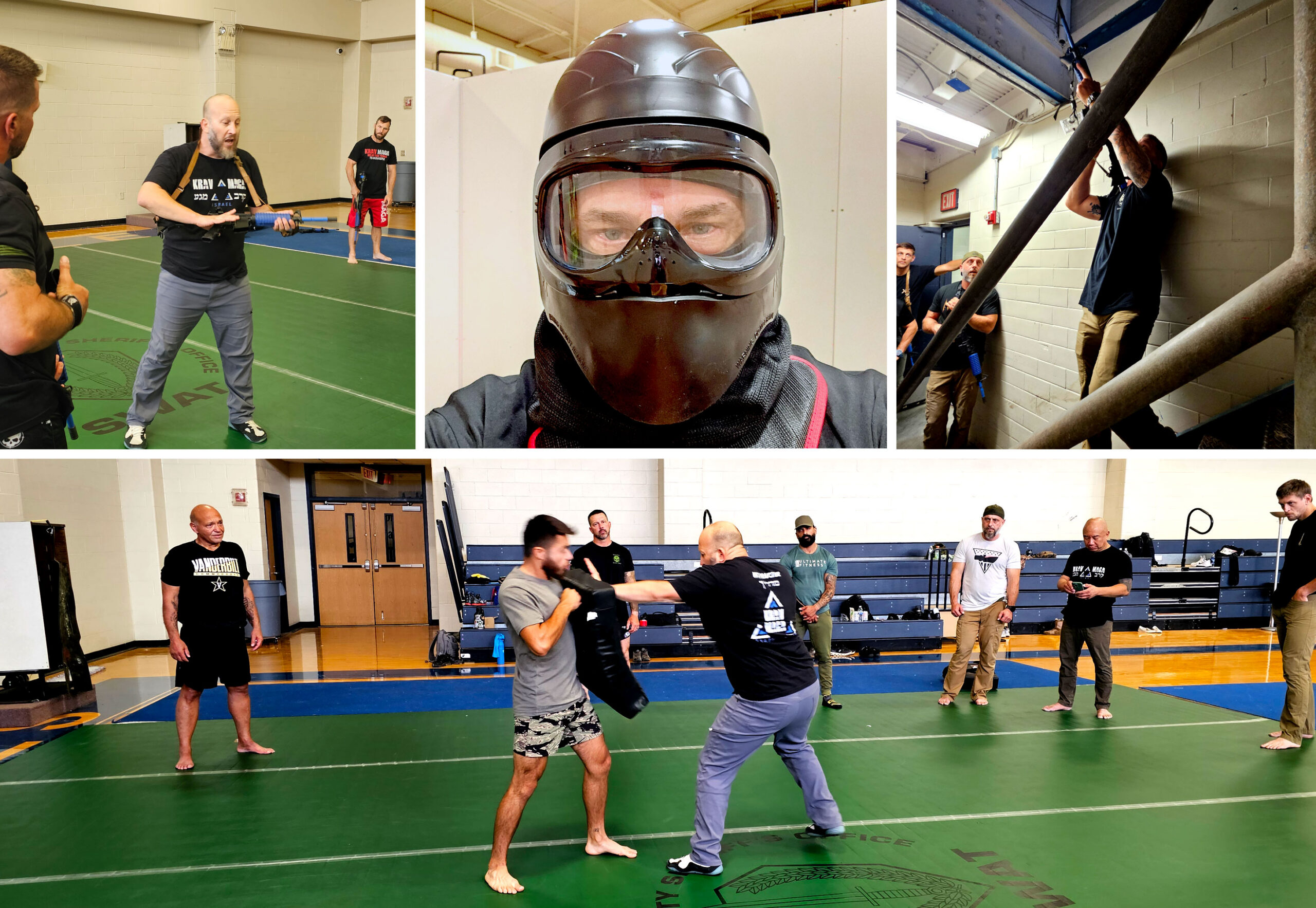
From the moment we arrived on the first day, we were moved into an old gymnasium, mats already down on the floor, lockers lining the walls. Music was playing while we warmed up: “Iron Man,” “We Will Rock You,” “Wasted Years,” and other classic-rock remakes, courtesy of a Spotify playlist called Fake Music Presents Outlaw Country. It wasn’t background noise so much as a signal: this was going to be physical, and it would demand focus.
The days followed a rhythm that repeated for the length of the course: four hours of Krav Maga training, an hour to an hour and a half of lecture on home defense (material built, quite literally, from lessons learned through blood on October 7th), and then hours of weapons training layered on top of that.
That structure wasn’t accidental. The physical training left you tired in the way real stress leaves you tired: heart rate up, hands less steady, thinking a little slower than you’d like. And that’s exactly the state the instructors wanted us in before we sat down for the lecture portion. It’s one thing to hear “the body will not behave normally under stress” as an abstract idea. It’s another to feel your own hands shaking slightly as you take notes on a decision-time ladder forty-five minutes after a hard round of pad work. The course wasn’t just teaching information; it was teaching us to absorb and use information while already depleted, which is precisely the condition anyone actually facing a threat will be in.
By the time each day ended, your body was exhausted, your mind had absorbed a lesson in hardcore history, and will have faced several weapons threats: knife, pistol, or rifle. All three, every day, back-to-back. Nobody walked out of that gym forgetting what they’d learned, including the hardest lesson of all: you never win a hand-to-hand knife fight. You may survive one, but you will carry the scars to prove it.
The Venue: A Building Rebuilt from Its Own Tragedy
It’s worth pausing on where this all actually happened, because the building has a story of its own that fits right alongside everything else in this article.
The Montgomery County Reality Based Training Center sits in New Caney, Texas, inside what used to be an ordinary school. It closed its doors in 2019, and when you walk the halls today, you still see the old signage for students and faculty, classrooms filled with tables and chairs for the students, even a library with shelving and materials. Nobody stripped the building down to make it feel like a training facility. It already was one, and that was exactly the point.
The center exists because of a different tragedy entirely. In the aftermath of the 2022 Uvalde school shooting, Texas Lieutenant Governor Dan Patrick pushed for a facility where law enforcement, fire, and EMS personnel could train for active-attack response inside a real building, not a mockup, the same way agencies like the FBI and Secret Service train inside actual cities, schools, and buildings rather than sterile classrooms. Montgomery County began operating the site in October 2022, in partnership with the Montgomery County Sheriff’s Office, the county’s Office of Homeland Security and Emergency Management, and the State of Texas. Sheriff Rand Henderson, Judge Mark Keough, Patrick, and other state leaders formally unveiled it in May 2024, as the first facility of its kind in Texas. Today it offers training to first responders from anywhere in the country, including active-attack rifle courses, integrated tactical emergency medical response, and the kind of reality-based scenario training that put Krav Maga Israel’s home defense course in a real school.
It’s a small detail, but it says something: the same instinct that built this course out of the lessons of October 7 is the same instinct that turned a closed-down school into one of the most realistic training environments in the country. Different tragedies, different countries, the same response. Take the worst day, and build something out of it that protects the next family.
A Brief History: When Terrorism Went Global
History shows that successful methods of terrorism rarely remain isolated. Aviation hijackings reshaped airport security. Suicide bombings changed urban security planning. Vehicle attacks spread across continents. Attackers adapt, and responsible people must adapt as well. Preparedness is therefore a continuous process rather than a single purchase or one-time plan. Communities tend to absorb the lesson only after the cost has already been paid.
Israel has, unfortunately, sat at the front of that learning curve more than once. On July 23, 1968, an El Al flight from Rome to Tel Aviv was hijacked, setting off a wave of aviation terrorism that would eventually touch nearly every country in the world. A few years later, an El Al security guard aboard another flight engaged hijackers directly, a moment that helped shape the modern practice of armed sky marshals, passenger behavioral profiling, and hardened cockpits. Those countermeasures, developed in response to a handful of incidents in the 1960s and ’70s, are the reason air travel looks the way it does today.
The pattern repeated with suicide bombings on public buses during the early 2000’s, which drove the construction of Israel’s West Bank security barrier and a sharp drop in that specific tactic. It repeated again with the rise of vehicle-ramming attacks in the mid-2010s, a low-tech method that spread from the Middle East to Europe and eventually the United States, culminating in tragedies like the 2016 truck attack in Nice, France.
“When something works, it gets adopted.”
Which raises an uncomfortable but necessary question for anyone in the preparedness community: what’s next, and are we watching for it?
What Made October 7 Different?
The October 7, 2023, attack was not a spontaneous act of violence. It was a complex, coordinated operation that appears to have involved years of planning, intelligence gathering, rehearsals, and deception.
One of the most important lessons from that day is that the attackers did not simply attack people; they attacked the systems people depended on for security. Communications were disrupted, observation systems were degraded, response forces were delayed, and multiple locations were struck simultaneously. Communities that had grown accustomed to a sophisticated security environment suddenly found themselves isolated and largely responsible for their own survival during the opening hours of the attack.
Attackers entered southern Israel in multiple waves and from multiple directions, overwhelming local defenses and creating confusion about the size and location of the threat. Many residents initially believed they were dealing with a small-scale security incident. Dozens of communities, military positions, and civilian gathering places were being attacked at the same time. The scale of the operation meant that information was incomplete, communications were disrupted and help often took far longer to arrive than anyone expected. The attack killed more than 1,200 people, injured thousands more, and resulted in more than 200 people being taken hostage into Gaza.
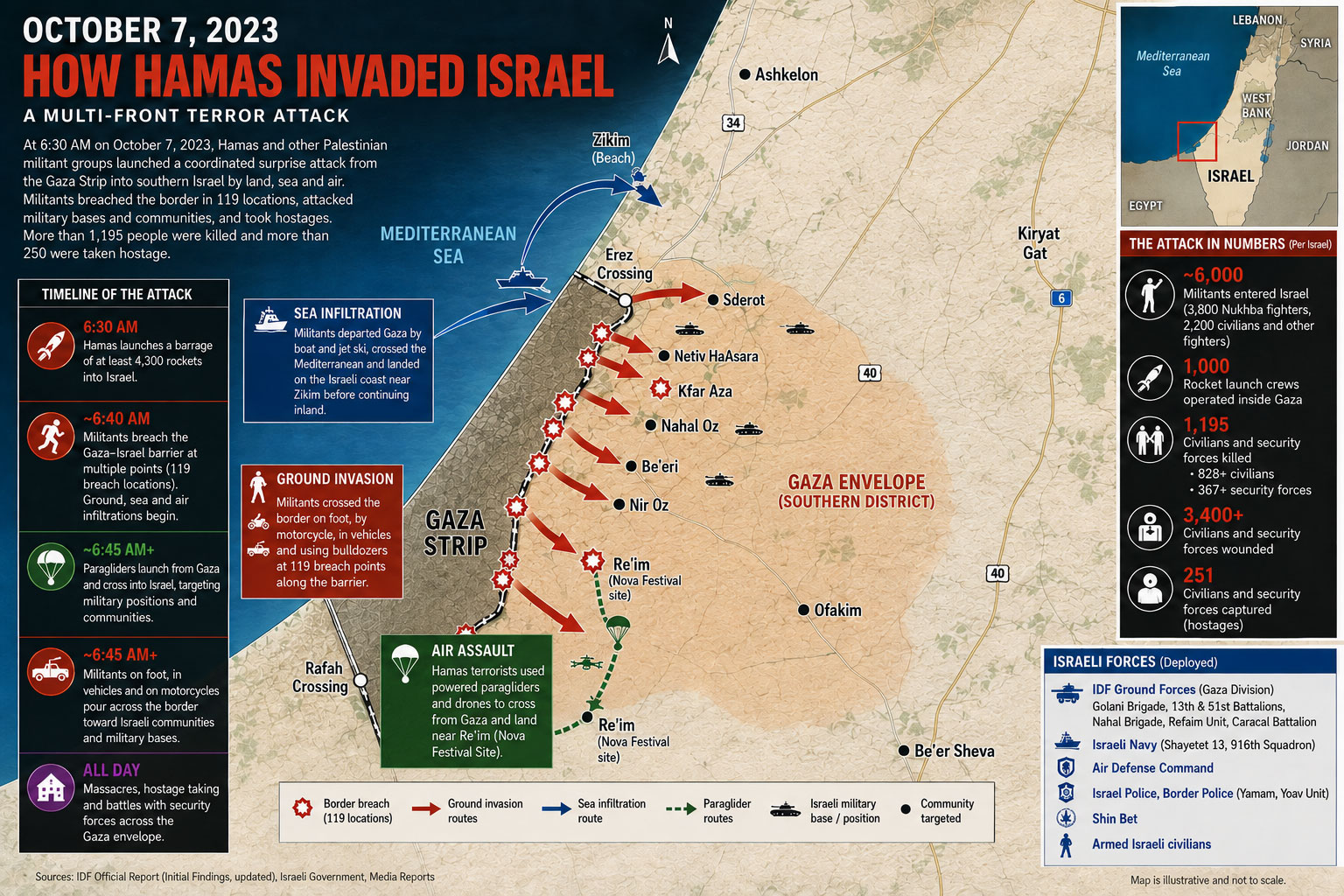
The attack also demonstrated the value attackers placed on intelligence preparation. They appeared to possess detailed knowledge of many of the communities they targeted, familiarity with roads, neighborhoods, layouts, and infrastructure that allowed them to move quickly and exploit vulnerabilities before defenders fully understood what was happening.
Perhaps the most significant lesson for civilians is that modern attacks often begin with confusion. Most people imagine danger arriving with obvious warning signs. The reality is that confusion, uncertainty, conflicting reports, and incomplete information often accompany the opening stages of a crisis. On October 7, many families had to make life-and-death decisions before they understood the full nature of the threat.
For the students and instructors at Krav Maga Israel, these events reinforced several principles that became recurring themes throughout the Integrated Home Defense course. Those lessons became the foundation of the training I attended in Texas.
- Detection creates time.
- Delay creates options.
- Communication creates coordination.
- Plans matter, but adaptability matters more.
- Protecting people is more important than protecting property.
- The first responder is often the person already on scene.
Lesson One: Security Is a System, Not a Product
One theme Ron repeatedly reinforced was that people often try to purchase security rather than build it. Many homeowners believe a firearm, alarm system, camera, or reinforced door is the solution. The reality is that no single tool creates safety: security is a layered system. The course kept returning to the same building blocks: information, detection, delay, communication, planning, and response.
The instructors framed it as four concentric rings, moving from the outside in:
INFORMATION → PROPERTY → STRUCTURE → PROTECTED SPACE
- Information is your outermost layer: a neighborhood text chain, a habit of noticing when something feels off, situational awareness before a threat ever reaches your property. One instructor called this “tactical curiosity”: if someone’s behavior doesn’t add up, it’s worth a quiet mental question, not paranoia, just interest.
- Property is your perimeter: fencing, lighting, cameras, and landscaping that doesn’t give an approaching threat anywhere to hide. As one instructor put it, “Evil doesn’t like light.”
- Structure is the building itself. A detail that surprised more than a few students: most doors fail at the frame, not the lock. Reinforcing the frame, adding security film to ground-floor windows, and literally counting every access point into your home (doors, windows, sliders, pet doors, basement and second-story entries) matters more than any single deadbolt.
- Protected Space is the innermost ring: a safe room, or simply the best available room in the moment, chosen for being reachable, defensible, equipped for communication, and having a way out.
A firearm may be one component of that system, but it is not the system itself. The most prepared families are often not the ones with the most equipment; they’re the ones who have thought through the problem in advance.
Lesson Two: Detection Creates Time
This became one of the recurring mantras of the course: detection creates time.
Time is the most valuable commodity during a crisis. Every layer of awareness (cameras, motion lights, dogs, alarm systems, neighborhood awareness, reinforced entry points) creates additional seconds or minutes for decision-making.
The goal isn’t necessarily to stop an attack immediately. The goal is to buy time. Time allows families to move, to communicate, to decide, and ultimately, to survive. The instructors framed it almost as an equation: detection plus delay equals decision time.
Lesson Three: Delay Creates Options
The second half of the equation follows naturally: delay creates options.
Even small delays can dramatically alter outcomes: a locked gate, a reinforced door, security film on a window, a barricaded bedroom, a safe room. Each obstacle forces an attacker to spend time solving a problem, and every second spent defeating an obstacle is a second defenders can use to carry out their plan.
The course also introduced what instructors called a “decision-time ladder”: thinking through what’s possible at 30 minutes out, 5 minutes out, 1 minute out, and 10 seconds out. The options available to a family shrink dramatically as that window closes, which is exactly why the earlier rings (information and property) matter so much: they’re what buy you the 30 minutes instead of the 10 seconds.
Lesson Four: Plans Matter, But Adaptability Matters More
One of the most valuable discussions in the course involved emergency planning.
Most people imagine that emergencies will unfold exactly as they envisioned. Reality rarely cooperates. Children may not be where they’re supposed to be. Family members may be separated. Communication may fail. Information may be incomplete.
The instructors emphasized that plans matter because they create a starting point, but a plan is not a script. Good plans create flexibility rather than rigidity. Prepared people adapt.
This showed up most clearly in a simple framework the course called the survival decision tree: Shelter, Defend, Escape, or Evade & Hide. None of these is a default; the right choice depends entirely on the threat in front of you, and a family needs to be able to move between them as a situation changes: from sheltering to escaping, from defending to moving, from escaping to hiding. A few reframes stuck with me:
- Shelter is not “do nothing.” It means actively gathering loved ones, locking or blocking access, communicating, and staying ready to change the plan.● The defender is not there to “win.” The defender is there to protect people, full stop.
- The safe room is not magic. It’s only useful for as long as it’s actually protecting you.
- Evade and hide is not cowardice. It’s survival, chosen when the other options are worse, a lesson the instructors returned to often when discussing October 7.
Lesson Five: Protect People, Not Property
This theme surfaced repeatedly throughout scenario discussions. Many people instinctively focus on possessions during emergencies: vehicles, homes, electronics, valuables. The instructors consistently redirected students toward a more important priority: protect people first. Property can be replaced. People cannot.
One instructor’s scenario advice stuck with me: if a threat only wants “stuff,” let them have it. The objective was never to win a confrontation over a television. The objective is to get everyone home alive.
This principle influences decisions involving evacuation, safe-room use, movement through structures, family accountability, and use of force. It also reframes the whole idea of a door: it’s not about the door, it’s about the people behind it. The door delays. The camera or alarm warns. The family moves. The defender’s job is to protect the people, not to win a fight at the threshold. That distinction, home defense versus offensive room-clearing, was one the instructors were careful to draw a hard line around.
One of the more interesting dynamics of the course was that not everyone teaching it started the week as an instructor. Nick Rians signed up as a student like everyone else. But his background as a former U.S. Marine (2/4 Infantry Battalion), urban warfare specialist, and the owner of Ghost Ring Tactical was hard to ignore once the class moved into clearing tactics, and the cadre pulled him in to teach alongside them, drawing on lessons from his own deployments across the Middle East rather than a manual. It said something about how the course was actually run: expertise mattered more than whatever role you’d signed up for.
Lesson Six: The First Responder Is Often Already There
This lesson resonated strongly with me because of my experiences during Route 91.
Many people assume help will arrive quickly. Sometimes it does. Sometimes it doesn’t. On October 7, response systems were overwhelmed. At Route 91, chaos and confusion dominated the first critical moments. The instructors were blunt about this:
“Until help arrives, you are the response.”
The reality is that the first responder is often a parent, a spouse, a neighbor, a citizen, or a bystander: the person who is already present. Preparedness is about increasing the likelihood that the decisions that person makes are informed rather than improvised.
Lesson Seven: Communication Is a Survival Skill
One of the more interesting portions of the course involved communication planning.
Most families have never discussed who calls 911, who gathers the children, what happens if cell networks fail, where family members meet, or how they communicate if separated. The instructors stressed that communication failures frequently create secondary problems during a crisis, and that family separation during an emergency should be treated as likely, not as an exception. Kids at school, an adult at work, a phone network overwhelmed: plan for that reality rather than assuming everyone will be together when it matters.
A few practical habits from the course:
- One person owns outbound communication during an incident, so the family isn’t talking over itself.
- Establish rally points, both inside the property and at an external location away from home, and decide in advance who is responsible for gathering the children if the family is scattered.
- Use simple, unambiguous trigger words everyone in the family recognizes instantly: go now, leave now, hide, stop, wait, stay, rally. Under stress, the body does not behave normally, and complicated instructions fall apart.
- Simple tools survive stress; complicated ones don’t.
- Have a backup plan for when technology fails. A coordinated family text group is useful until the network is overwhelmed or the power goes out. Battery backups for cameras and alarms, and even off-grid mesh-radio options for family communication, came up as ways to keep a communication plan alive when infrastructure doesn’t.
Technology can help, but planning matters more. Everyone in a family should know their rally points, contact procedures, emergency responsibilities, and backup communication methods, because communication creates coordination, and coordination creates survival.
Beyond the Safe Room
One point the instructors returned to more than once: survival doesn’t end once you reach the safe room. A well-prepared space also includes a basic trauma kit and “Stop the Bleed” supplies, critical medications, water and light, and any specific needs for children or elderly family members. Fire was flagged as its own complicating factor entirely: a fire extinguisher and a plan for smoke (stay low) belong in the same conversation as physical security, because a fire changes every other decision on the table.
None of this is about assuming the worst is coming. It’s about not being caught flat-footed by whatever ordinary emergency (a break-in, a fire, a severe storm) actually does show up.
Home
On day four, after class ended, I thought I’d have time to head back to the hotel, shower, change clothes, and make my flight. Not a chance.
I left the Montgomery County Reality Based Training Center exactly as I’d finished the course. My forearms were covered with bruises. The skin on both arms had been broken in several places from Simunition rounds. My hands still smelled like gunpowder, and my clothes carried four days’ worth of sweat, mat work, and range dust. I drove straight to the airport.
Walking through the terminal, I couldn’t help but laugh to myself. If TSA had pulled me aside for additional screening, I wouldn’t have blamed them, I looked exactly like someone who’d spent four days fighting, rolling on the ground, and getting shot at.
It had been an outstanding course. Ron Engelman, Daniel Peña, Wesley Mack, and every student in that room had come for the same reason: to become a little harder to kill, a little harder to surprise, and a little better prepared to protect the people who matter most.
But somewhere over Texas, I realized the biggest lesson I was taking home wasn’t physical. It wasn’t a new Krav Maga technique, another way to clear a room, or another shooting drill. It was a different way of thinking.
When I finally walked through my front door back in California, I didn’t immediately start shopping for new equipment. I didn’t start looking at cameras, order reinforced doors, or buy another firearm. Instead, I walked through my own house, for the first time, not as a homeowner, but as someone responsible for protecting another human being.
I counted every exterior door. Every window. Every sliding glass door. Every place someone could enter, and every place Julie and I could move. I looked at every room that could become a temporary safe room, every hallway that created a bottleneck, and every decision we would have to make before law enforcement ever arrived.
I wasn’t looking for expensive solutions. I was looking for time. That was one of the biggest lessons Ron repeated throughout the course: detection creates time, delay creates options, and options save lives.
The truth is, I already owned many of the things people assume make a home secure: cameras, firearms, medical equipment, training. But the course reminded me of something simple. Security isn’t something you buy. It’s something you build, one layer at a time, one conversation at a time, one plan at a time, one family at a time.
When people hear the words “home defense,” many immediately picture firearms. Those certainly have a place, but if that’s where your planning begins, you’ve already skipped most of the lesson. Home defense begins long before anyone kicks in a door. It begins with awareness. It begins with communication. It begins with deciding today what you’ll do tomorrow. It begins with loving the people in your home enough to have uncomfortable conversations before you’re forced to have impossible ones.
As Lt. Col. Dave Grossman says, “Love protects.” After spending four days with Krav Maga Israel, I finally understand that statement better than I ever have. Love isn’t passive. Love prepares. Love plans. Love trains. Love takes responsibility. And sometimes, love simply walks through the house one more time, seeing it with different eyes.
Closing Thoughts: Love Protects
After spending time with Krav Maga Israel, I came to appreciate Lt. Col. Dave Grossman’s phrase ‘Love protects’ in a deeper way than ever before. Route 91, October 7, parenthood, trauma medicine, and responsible home defense all point to the same truth: people prepare because they love someone enough to accept responsibility for protecting them. Love installs better locks. Love learns CPR. Love carries a trauma kit. Love develops a family plan. Love trains, not because violence is inevitable, but because those we care about are worth preparing for.
Preparedness is not fear. Preparedness is responsibility. And responsibility, at its core, is an expression of love.
This is not the end of my time with Krav Maga Israel. This was only the beginning.
Somewhere on my bucket list for next year is a trip back to Israel itself: either one of Krav Maga Israel’s 7-day Immersion Camps or one of their 7-day Instructor Program workshops. Training on the beach in Israel, in the homeland of where Krav Maga was developed, isn’t just a box to check. It’s the next chapter of the same story: taking what I learned in that gymnasium in Texas and going deeper, back to the source, so I can bring more of it home to the people I train here.
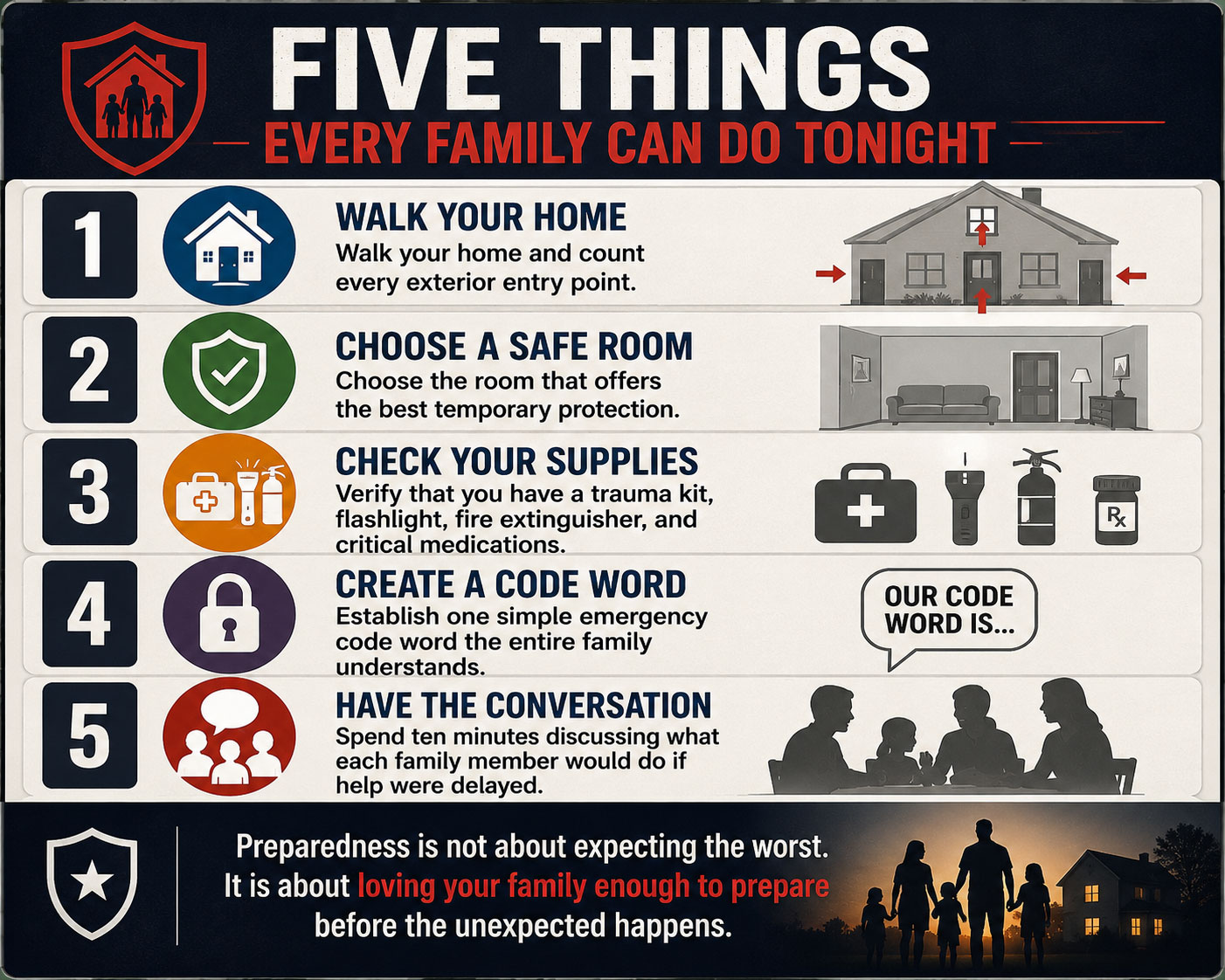
Five Things Every Family Can Do Tonight
1. Walk your home and count every exterior entry point.
2. Choose the room that offers the best temporary protection.
3. Verify that you have a trauma kit, flashlight, fire extinguisher, and critical medications.
4. Establish one simple emergency code word the entire family understands.
5. Spend ten minutes discussing what each family member would do if help were delayed.
Preparedness is not about expecting the worst. It is about loving your family enough to prepare before the unexpected happens.
Preparedness is not fear. It is responsibility. And responsibility is one of the purest expressions of love.
TOM DURELL
Not Today Self-Defense & Firearms Training